


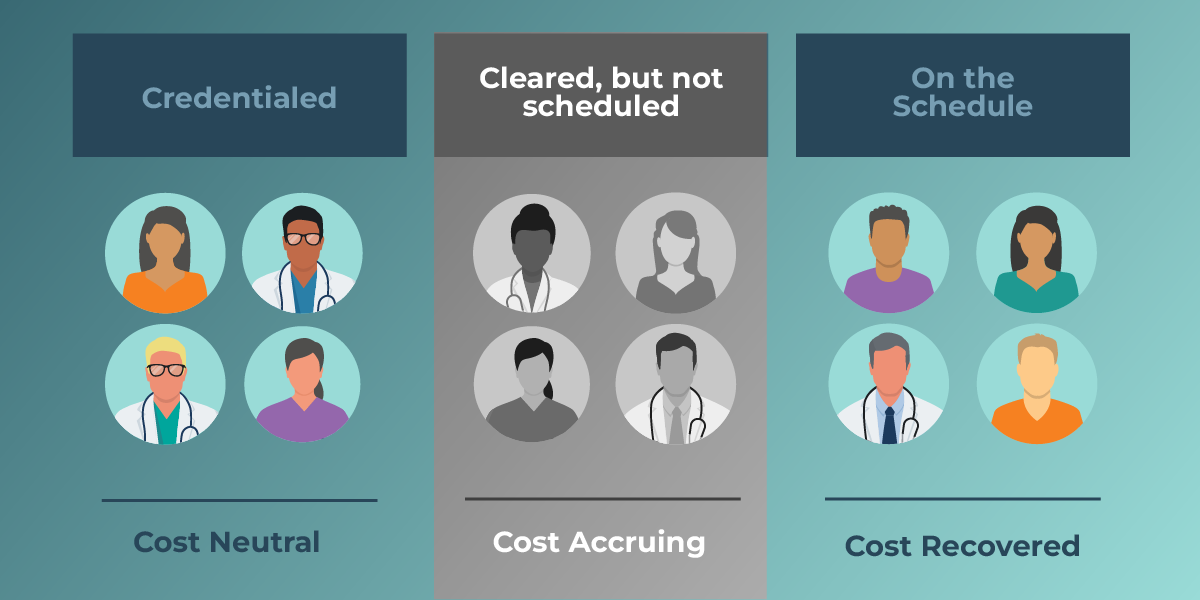
SUMMARY: Most healthcare organizations think of credentialing and eligibility as compliance tasks: boxes to check so providers can work. In reality, they’re also some of the most powerful levers in workforce economics, and some of the most overlooked. This isn’t a story about bad teams or bad intentions. It’s a story about incomplete information and what it costs.
When eligibility and credentialing data is incomplete, delayed, or scattered across systems, the impact goes far beyond a few frustrating emails. It distorts your view of internal capacity, forces unnecessary external spend, slows the deployment of new providers, and quietly fuels burnout and operational chaos.
What “Incomplete Eligibility Data” Actually Looks Like
When people hear “incomplete data,” they often picture missing fields in a database. In practice, it’s much more ordinary — and more damaging.
Common examples include:
- A provider is fully credentialed, but their status isn’t updated in the scheduling system.
- A clinician can work at Site A, but not Site B, and that nuance is buried in an email.
- Expiration dates are stored in one system while schedules are built in another.
- “Ready to work” means different things to credentialing, operations, and scheduling.
- New hires sit in a gray area: technically clear, practically invisible.
None of this is dramatic. All of it affects how leaders see their workforce.
When eligibility and credentialing information is fragmented, your picture of internal capacity is wrong — sometimes slightly, sometimes significantly.
How It Distorts Your View of Staffing Reality
Eligibility data doesn’t just say who can work. It shapes what everyone believes is possible.
When that data is incomplete:
- Schedulers think they have fewer internal options than they actually do.
- Operations assumes gaps can’t be covered without external help.
- Finance believes external spend was “required.”
- Clinical leaders think certain providers are unavailable when they’re not.
The result is a subtle but powerful distortion: you look understaffed even when you’re not.
When people can’t see ready, eligible providers in the tools they use every day, those providers might as well not exist.
Slow Handoffs Turn New Providers Into Idle Capacity
Organizations invest heavily in recruiting and onboarding new clinicians. But there’s often a lag between “credentialed” and “on the schedule.”
That lag is usually caused by:
- Eligibility status living in a different system than scheduling
- Unclear ownership for updating “ready to schedule” status
- Manual processes to notify schedulers or operations
- Templates that aren’t updated when new providers are cleared
From the outside, it looks like a hiring problem. On the inside, it’s a handoff problem.
Every week a credentialed provider sits underutilized is a week you’re paying for capacity you’re not using — while still leaning on overtime and external coverage.
The Financial Impact: When Data Gaps Turn Into Dollars
Incomplete eligibility and credentialing data creates a chain reaction:
- Internal capacity seems smaller than it is.
- Schedulers fill gaps with external providers or premium shifts.
- Finance sees a higher external mix and rising labor costs.
- Leaders assume the organization has a “staffing shortage” problem.
But in many cases, the real issue is that internal capacity is locked behind slow or incomplete data.
The financial impact shows up as:
- Higher agency reliance
- More premium pay
- More overtime
- Extended ramp time for new hires
- Budgets that drift off plan
The cost is real — even if the root cause doesn’t appear on any invoice.
The Human Impact: Burnout and Friction That Didn’t Need to Happen
Eligibility gaps also create very real human consequences.
When the same familiar providers are always the ones available in the system:
- They’re asked to pick up more shifts
- Their schedules get less predictable
- They carry more stress during surges
Meanwhile, other providers who could help lighten the load remain invisible because their status isn’t fully reflected in staffing workflows.
This imbalance contributes to:
- Perception of unfair scheduling
- Avoidable burnout
- Frustration between clinical teams and operations
- Distrust in “what the system says” about who’s available
What looks like a culture problem is often a data problem.
What Good Looks Like: A Connected Eligibility-to-Scheduling Workflow
High-performing organizations don’t treat eligibility as a static label. They treat it as a living signal that flows directly into scheduling and workforce planning.
In that model:
- Credentialing updates automatically surface in the systems schedulers actually use.
- “Ready to schedule” is clearly defined and consistently applied.
- Cross-site and cross-specialty eligibility is visible, not hidden in emails.
- Expiration risks are surfaced early, not discovered the week of.
- New providers show up as “bookable” as soon as they’re ready — not weeks later.
The goal isn’t perfection. The goal is a clean, reliable handshake between credentialing, operations, and scheduling.
When that handshake works, internal capacity stops getting lost.
Practical Steps to Reduce Eligibility Blind Spots
You don’t have to redesign your entire process overnight. Start with a few practical changes:
- Define a single owner for updating “ready to schedule” status.
- Standardize what “ready” means across credentialing, operations, and scheduling.
- Map where eligibility data lives today and where it needs to be visible.
- Identify which decisions are currently being made without up-to-date eligibility information.
- Create a simple, repeatable trigger for notifying schedulers when a provider becomes deployable.
Even modest improvements can produce meaningful reductions in idle capacity and external labor.
How Kimedics Helps Close the Eligibility Gap
Kimedics helps organizations turn eligibility and credentialing data into usable, operational insight — not static records.
With Kimedics, teams can:
- See credentialing and eligibility status alongside schedules and availability
- Surface newly ready providers immediately to schedulers and operations
- Track who is cleared for which sites and roles in one place
- Reduce “invisible capacity” that drives unnecessary external spend
- Shorten the time from “credentialed” to “on the schedule”
- Align credentialing, operations, finance, and clinical leadership around the same staffing truth
Eligibility and credentialing will always be complex. The data doesn’t have to be.
Ready to turn eligibility data into real staffing capacity?
Request a Demo
Learn more about Kimedics
Kimedics is a provider utilization management platform. We help healthcare organizations gain visibility across internal and external staffing to reduce complexity and improve financial performance. For more information, book a demo or email kimedics@kimedics.com