


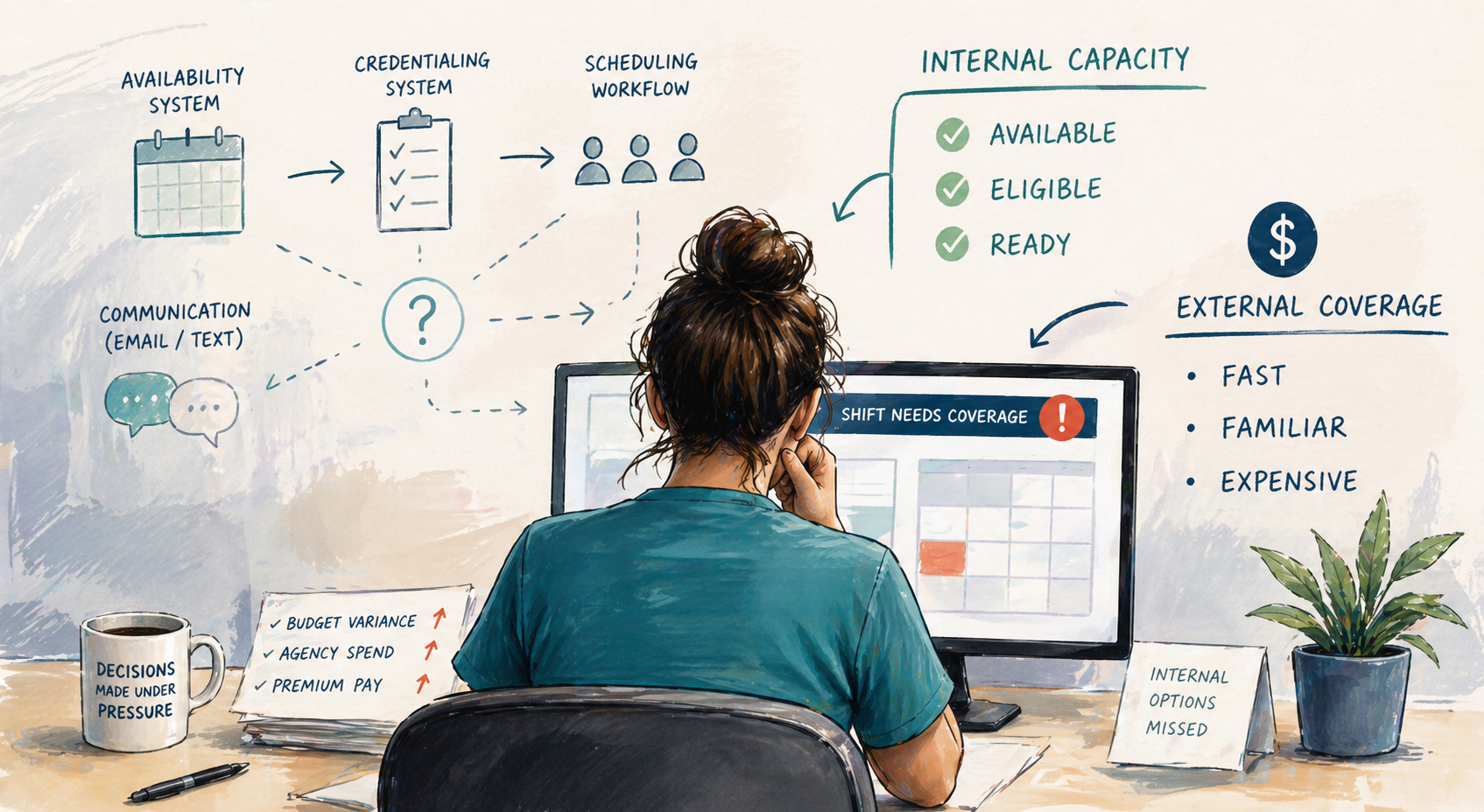
Short answer: Premium labor doesn’t persist because organizations lack capacity. It persists because internal capacity isn’t visible early enough to influence decisions.
It Usually Starts with a Reasonable Decision
A shift opens up, often later in the week.
The team is already balancing coverage, schedules, and competing priorities. There isn’t much room for delay. The goal is simple, get the shift covered with as little disruption as possible.
So the fastest path gets used.
External coverage is requested. Rates are approved. The gap gets filled.
At that moment, the decision makes sense.
What Wasn’t Visible At the Time
What often becomes clear later is that internal capacity existed.
A clinician had just cleared credentialing. Another had availability across sites. A recent hire was ready to work but hadn’t yet been surfaced in the scheduling workflow.
None of those options were visible when the decision needed to be made.
By the time they were, the external coverage was already confirmed.
This Is Where the Pattern Forms
Individually, these decisions are reasonable.
Collectively, they create a pattern.
External coverage starts to get used earlier in the process, not because it’s always necessary, but because it’s the most reliable option in the moment.
Over time, that shifts expectations.
External labor stops feeling like a backup plan and starts feeling like part of the baseline.
It Doesn’t Show Up As A Visibility Problem
On paper, the explanation is straightforward.
Demand is high. Supply is limited. External coverage fills the gap.
But when you look closer, the issue is rarely just supply.
It’s visibility.
Information about internal capacity exists, but it’s fragmented. Availability, eligibility, and scheduling workflows live in different places.
Updates arrive just late enough to change the outcome.
Decisions get made based on what’s visible, not what’s actually available.
The Cost Builds Quietly
Premium labor is easy to see at the rate level.
The broader impact is less obvious.
Internal capacity goes underutilized. New hires take longer to contribute. Workload concentrates across a smaller group of clinicians.
Budget variance grows, but without a clear link back to specific decisions.
None of it comes from a single moment.
It builds over time.
What Changes When Visibility Improves
The organizations that bring premium labor spend under control don’t eliminate external partners.
They change when those partners are used.
Internal capacity becomes easier to evaluate in real time. Newly ready clinicians show up immediately in the workflow. Teams operate from a shared view of availability, eligibility, and coverage options.
External coverage still plays a role.
It just stops being the default response.
The Difference Isn’t Policy, It’s Timing
Most organizations already intend to prioritize internal capacity.
The issue is not strategy.
It’s timing.
When the right information is visible early enough, decisions shift naturally. Internal options get used first. External coverage becomes more intentional. Spend aligns more closely with actual need.
The Takeaway
If premium labor spend continues to rise even as hiring improves, it’s worth asking a different question.
Not whether there is enough capacity.
But whether the full workforce is visible at the moment decisions are being made.
Because in many cases, the capacity is already there.
It just isn’t showing up in time to be used.
Request a Demo
Q
Why does premium labor spend continue to increase even when hiring improves?

Because new capacity often isn’t visible or accessible at the moment decisions are made. Hiring increases supply, but without clear visibility into that supply, external coverage continues to be used earlier than necessary.
Q
Is premium labor always a sign of a staffing shortage?
Not always. In many cases, it reflects how capacity is being accessed rather than how much exists. When internal availability isn’t clearly visible, external coverage becomes the most reliable option in the moment.
Q
Why do teams rely on external coverage even when internal options may exist?
Because external options are often easier to confirm quickly. When internal availability, eligibility, and scheduling are fragmented across systems, teams default to the option they can act on with confidence.
Q
What changes when internal capacity is easier to see?
Decisions shift earlier in the process. Internal options get used more consistently, and external coverage becomes a deliberate choice instead of a default response.
Q
Is reducing premium labor about eliminating external partners?
No. External partners still play an important role. The difference is in how they’re used. With better visibility, organizations can use external coverage where it adds value, rather than relying on it to compensate for gaps in coordination.
Learn more about Kimedics
Kimedics is a provider utilization management platform. We help healthcare organizations gain visibility across internal and external staffing to reduce complexity and improve financial performance. For more information, book a demo or email kimedics@kimedics.com