


SUMMARY: Healthcare leaders make hundreds of staffing decisions every month — and thousands of micro-decisions behind the scenes. Yet most organizations still feel like they’re always one shift away from chaos. This post breaks down why staffing decisions are so difficult, and what leaders can do to make them easier, more consistent, and more sustainable.
People often assume the problem is not enough staff, budget, or time.
These are real pressures, but they’re not the reason staffing decisions feel so hard.
The real reason is simpler: most teams are forced to make decisions without the clarity or alignment they need.
It’s not a talent problem. It’s not a commitment problem. It’s a decision-making problem — created by fragmented data, disconnected systems, and inconsistent information that makes every choice feel uncertain.
The Challenge: Decisions Without a Shared Picture
Ask any two departments what’s happening with staffing, and you’ll get different answers.
- Finance sees spend.
- Operations sees coverage.
- Clinical leaders see burnout.
- Schedulers see crisis after crisis.
Each perspective is valid — but none of them are complete on their own.
Staffing decisions feel hard because teams are making them without shared visibility, shared definitions, or shared context. When everyone is interpreting different pieces of the story, decisions become disagreements instead of solutions.
The Hidden Load: Too Many Inputs, Not Enough Insight
Operations teams don’t struggle because they don’t know what to do. They struggle because they’re overwhelmed with unclear, conflicting, or outdated information.
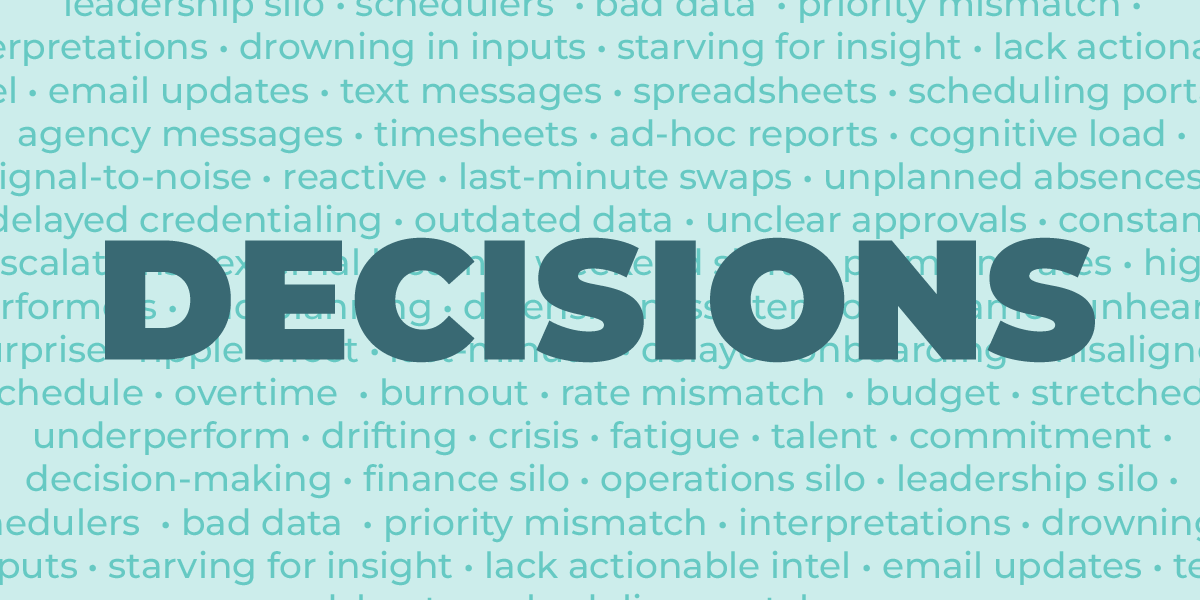
Every decision is surrounded by:
- Email updates.
- Spreadsheets.
- Text messages.
- Scheduling portals.
- Agency notes.
- HR status reports.
The burden isn’t the decision — it’s the mental load required to get to the decision.
When information is scattered, leaders spend more time pulling data together than interpreting it.
A Reactive System Creates Reactive Decisions
Even well-run organizations get caught in a cycle of:
- Last-minute shift changes.
- Call-outs and unplanned absences.
- Delayed credentialing and onboarding.
- Budget surprises tied to external staffing.
- Conflicting updates across teams.
When everything feels urgent, decisions become reactive by default. Teams choose what’s fast, not what’s strategic.
That’s how organizations end up:
- Booking locums when internal capacity exists.
- Paying premium rates for avoidable gaps.
- Overloading the same few high performers.
- Missing opportunities to rebalance workloads.
Reactive decisions aren’t caused by lack of discipline. They’re caused by a system that never gives teams room to get ahead.
When Decisions Feel Personal, Not Predictable
Without shared data, staffing decisions start to feel subjective.
“Why did we use a locum again?”
“Why is this provider overloaded?”
“Why didn’t we see this coming?”
“Why do the numbers never match?”
Schedulers feel blamed for decisions they didn’t create. Leaders defend decisions they aren’t confident in. Finance sees surprises they can’t explain.
A good staffing system should make decisions clear, predictable, and fair — not personal.
The Ripple Effect: Decisions Without Visibility Create Cost and Burnout
Every staffing decision creates downstream impact.
- A single call-out affects locum usage.
- A delayed onboarding affects provider balance.
- An uninformed scheduling change affects overtime.
- A missed forecast affects budget variance.
But without connected data, leaders see the decision — not the consequences.
Decisions feel heavy because leaders know they matter but can’t see how they connect.
The Opportunity: Make Staffing Decisions Easier (and Smarter)
Fixing staffing means fixing decision-making. Here’s how healthcare organizations can do that:
- Provide one shared, real-time picture. When every team sees the same information in the same place, decisions become faster, more aligned, and easier to justify.
- Reduce noise and highlight what actually matters. Decision-makers need clear visibility into utilization, workload balance, credentialing status, and internal vs. external mix — not 20 disconnected dashboards.
- Build guardrails that create fairness. When rules and expectations are consistent, decisions stop depending on who happens to be involved.
- Shift from last-minute fixes to anticipatory planning. When teams can see chronic shortfalls, overuse, and unreliable patterns, they can act before the fire starts.
- Use tools that reflect real-world workflow. Schedulers and leaders need systems built for the way healthcare actually operates, not for an idealized version where everything goes right.
How Kimedics Helps
Kimedics connects scheduling, spend, onboarding, credentialing, utilization, and agency workflows in one place — giving healthcare teams the clarity they’ve been missing.
- Compare internal and external capacity in a single view.
- See workload balance clearly across providers and sites.
- Forecast needs using real operational signals.
- Reduce locum dependence through better planning.
- Understand cost and coverage together, not in separate systems.
- Make decisions faster, fairer, and with more confidence.
Clarity reduces stress. Connection reduces friction. Shared insight reduces conflict.
When leaders have all three, staffing decisions stop feeling like emergencies — and start feeling like leadership.
Make Staffing Decisions Easier. Make Them Smarter.
- With Kimedics, every team works from the same staffing truth.
- The clearer the picture, the easier the decision.
Ready to make better staffing decisions?
Request a Demo
Learn more about Kimedics
Kimedics is a provider utilization management solution. We help healthcare organizations reduce scheduling complexity. For more information, book a demo or email kimedics@kimedics.com