


SUMMARY: In healthcare operations, “normal” has quietly shifted over the years. What used to be occasional staffing turbulence has become a daily expectation: gaps to fill, shifts to cover, sudden absences, late-breaking updates, credentialing uncertainties, fluctuating demand, and the constant need to make decisions faster than information travels. This post breaks down why so many organizations feel trapped in reactive staffing and what high-performing teams do to reclaim control.
Staffing teams don’t operate in chaos because they lack skill. They operate in chaos because the system around them wasn’t built for calm. Yet some organizations have found a way out of this pattern. Their staffing teams aren’t sprinting from fire to fire. They aren’t constantly reacting. They aren’t drowning in last-minute surprises.
Instead, they run on a predictable cadence that allows them to plan, adjust, and stay ahead of demand.
The Root Cause of "Firefighting:" Information Arrives Too Late
Most staffing emergencies aren’t true surprises. They’re late discoveries.
Teams typically learn about changes only when the consequences hit:
- A provider becomes eligible but no one communicates it
- A credentialing delay surfaces only when the schedule is already built
- Volume rises at a location before anyone shares the trend
- Someone takes PTO but the update doesn’t flow into scheduling
- A provider reduces availability, but that change stays in an email
- Onboarding is complete, but no one signals that the provider can be deployed
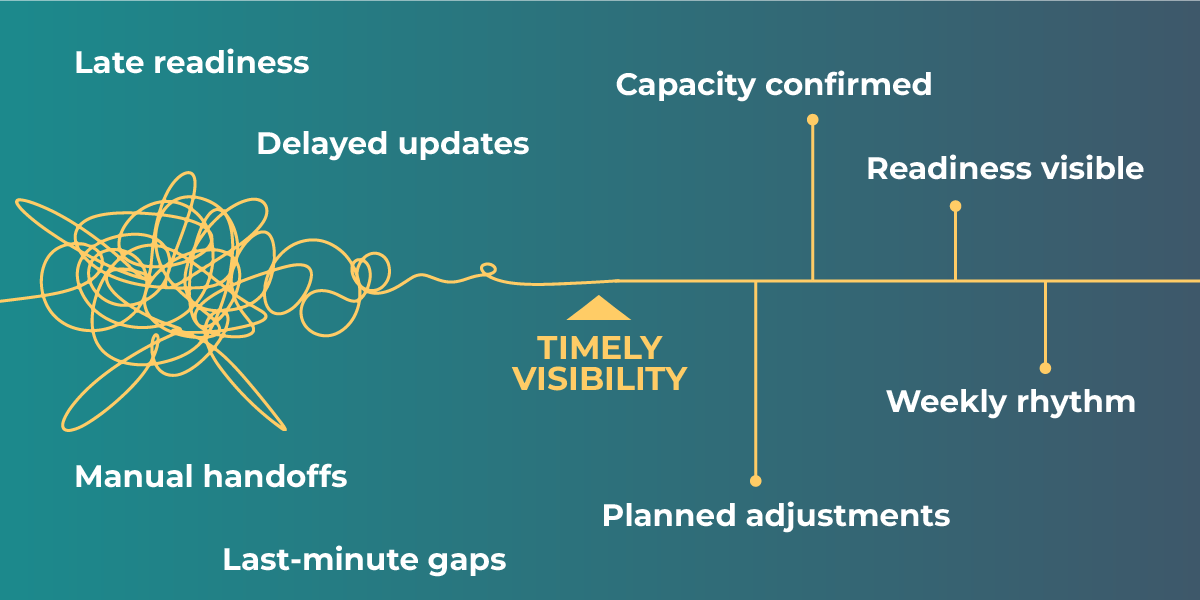
By the time the staffing team sees the data, it’s no longer “information” — it’s an emergency. Firefighting ("putting out fires") is rarely about lack of time. It’s about lack of timely visibility.
Capacity Looks Unpredictable When It Isn’t Actually Unpredictable
Staffing teams often feel like internal availability changes constantly. In reality, internal capacity is more stable than it appears — it just isn’t surfaced in a consistent, operationally useful way.
Capacity becomes unclear when:
- Readiness isn’t updated in the system that scheduling uses
- Eligibility lives in a different workflow than staffing
- Cross-site assignments aren’t visible
- Internal options are hidden behind manual processes
- New hires don’t show up as “deployable” until someone remembers to add them
When teams can’t see internal supply clearly, they can’t plan confidently. Planning requires visibility, not guesswork.
Templates, Cadences, and Workflows Aren’t Keeping Up With Reality
Another common source of reactivity: outdated staffing structures. Many organizations still operate with:
- Templates built months ago that no longer reflect real demand
- Scheduling cadences that lag behind operational needs
- Review cycles that don’t match the pace of change
- Credentialing and scheduling operating on completely different clocks
These aren’t failures. They’re artifacts — processes that made sense once but haven’t evolved with the complexity of modern healthcare operations. Firefighting is the natural outcome when workflows move slower than the work itself.
Firefighting Creates Hidden Financial and Human Costs
Constant reactivity doesn’t just drain energy, it drains resources.
Financial costs
- Higher premium pay
- External coverage that could have been avoided
- Lost productivity from delayed deployment
- Budget drift from underestimating internal capacity
Operational costs
- Teams lose the ability to plan ahead
- The schedule becomes fragile rather than strategic
- Decision-making collapses into the path of least resistance
Human costs
- Burnout among providers repeatedly asked to pick up extra shifts
- Frustration among schedulers who never get to work ahead
- Tension between clinical and operational teams
When everything feels urgent, nothing feels sustainable.
High-Performing Staffing Teams Don’t React Faster — They React Less
The best staffing teams aren’t superheroes. They’re just not living in survival mode. They reduce firefighting by creating conditions where emergencies occur less often. Here’s what they do differently:
1. They establish a predictable weekly operating rhythm
This includes:
- Reviewing upcoming gaps
- Confirming readiness and eligibility
- Validating internal supply
- Adjusting templates based on real trends
- Aligning finance, ops, and clinical leadership
It shifts staffing from a series of surprises to a series of checkpoints.
2. They make internal capacity visible — instantly
When internal resources are easy to see, they get used. This reduces reliance on premium shifts and external labor.
3. They connect credentialing directly to scheduling
No more handoffs getting lost in inboxes. If someone is ready, the staffing team sees it immediately.
4. They minimize the number of decisions made under pressure
The more decisions made with lead time, the fewer emergencies appear.
5. They use data to anticipate patterns rather than react to them
Not forecasting in the technical sense — just recognizing trends early enough to act.
This isn’t complexity. It’s discipline.
What Forward Planning Looks Like in Practice
Organizations that break out of firefighting mode consistently demonstrate:
- Stable weekly rhythms
- Fewer surprises in the schedule
- Reduced external reliance
- Smoother onboarding-to-scheduling transitions
- Better workload balance
- Higher trust across teams
- More accurate budgets
- Less burnout and fewer escalations
And most importantly: the staffing team is no longer the pressure valve for the entire organization. They’re the stabilizing force.
How Kimedics Helps Teams Move From Firefighting to Forward Planning
Kimedics gives staffing teams the visibility and operational structure they need to stay ahead of demand instead of reacting to it.
With Kimedics, teams can:
- See readiness, eligibility, and availability in real time
- Align credentialing, operations, and scheduling in one workflow
- Get earlier visibility into gaps and internal options
- Reduce last-minute surprises through connected data
- Maintain a predictable weekly planning cadence
- Lower external spend by making internal resources easier to deploy
- Build staffing plans that reflect reality, not assumptions
Firefighting isn’t inevitable. It’s a symptom of fragmented signals. When teams share the same view, they can finally operate with intention instead of urgency.
Ready to help your staffing teams spend less time firefighting — and more time planning?
Request a Demo
Learn more about Kimedics
Kimedics is a provider utilization management platform. We help healthcare organizations gain visibility across internal and external staffing to reduce complexity and improve financial performance. For more information, book a demo or email kimedics@kimedics.com