


SUMMARY: Healthcare staffing rarely unravels because of one big failure. It drifts off course through a series of small, disconnected decisions that quietly move teams away from the staffing strategy leadership believes they’re executing.
In most organizations, the problem isn’t a lack of smart people, dedicated schedulers, or careful leaders. The problem is that each team (operations, finance, clinical, HR, agency partners) is working with slightly different data, timelines, constraints, and assumptions.
When decisions are made with different information, in different systems, at different times, the organization slowly loses control of staffing without realizing it.
Here’s why that happens, what it looks like in real life, and how healthcare organizations can get back on course.
1. Too Many Systems, Not Enough Shared Truth
Most healthcare organizations don’t suffer because they lack tools. They suffer because they have too many tools that don’t talk to each other.
- Scheduling lives in one system.
- Credentialing in another.
- Timekeeping somewhere else.
- Finance uses its own spreadsheets and reporting tools.
- Agencies have their own portals, formats, and timelines.
Each system tells part of the story. None of them tell the whole story. So when a decision needs to be made, for example about coverage, spend, overtime, staffing mix, or locum usage, every stakeholder is looking at a slightly different version of reality.
- Schedulers see open shifts.
- Operations sees throughput or coverage risk.
- Finance sees budget variance.
- Clinical leaders see burnout and quality pressures.
Everyone is right based on what they see. Yet everyone is making decisions the others can’t fully interpret or anticipate.
That is how drift begins.
2. Local Decisions Overpower Organizational Strategy
Staffing decisions often sit closest to the teams who feel the pressure most immediately:
- Site directors
- Practice managers
- Scheduling teams
- Clinical leads
- Agency coordinators
They make practical decisions to fix today’s problems. The issue isn’t judgment. It’s misalignment.
A reasonable local decision can conflict with:
- Financial goals
- Provider workload expectations
- Internal vs. external staffing targets
- Organizational commitments around burnout
- Planned recruitment timelines
When hundreds of local decisions accumulate over time, they push the organization away from what leadership intended.
The strategy says one thing. The workflow says another. Reality follows the workflow.
3. Everyone Owns a Piece of Staffing, But No One Owns All of It
Healthcare staffing spans so many roles that no single leader sees the entire lifecycle:
- Recruiting
- Onboarding
- Credentialing
- Scheduling
- Agency management
- Payroll
- Finance
- Clinical leadership
Each team gets a narrow slice of staffing responsibility. No one owns the holistic picture.
This creates blind spots like:
- Providers who are credentialed but not marked ready
- Availability updates that disappear in email threads
- Underutilized clinicians no one notices
- Costs rising without context
- Workload imbalance masked by surface-level metrics
Without a connected view of staffing from “intent” to “execution,” drift is guaranteed.
4. The Default Becomes “What’s Fastest,” Not “What’s Best”
When information is fragmented, teams naturally default to the easiest option:
- Call the same agency contact
- Ask the same reliable provider to pick up
- Copy last month’s schedule template
- Approve a shift without seeing cost data
- Skip internal options because availability isn’t clear
- Accept outdated credentialing statuses as current
None of these actions are wrong. But repeated thousands of times, they reshape the organization’s staffing reality.
Healthcare teams don’t lose control because they make bad decisions. They lose control because they make uninformed decisions.
5. How Organizations Regain Control
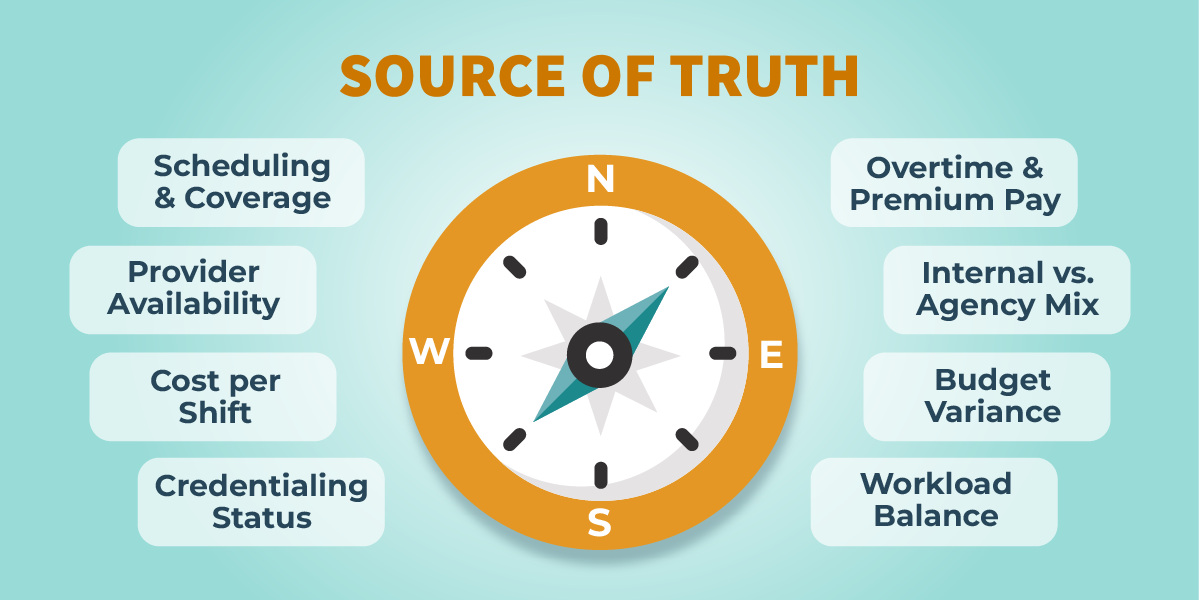
Leading organizations don’t solve drift by centralizing every decision. They solve it by aligning every decision-maker around the same source of truth. They do three things differently:
- Create One Connected View of Staffing Data
Availability, readiness, utilization, external usage, and cost exist in one place so everyone sees the same picture. - Align Finance, Operations, and Clinical Leadership
Teams stop debating whose numbers are “right” and instead collaborate using the same shared metrics. - Make Strategic Choices Easier Than Quick Fixes
When internal options, eligibility, and cost are visible at the decision point, the right decision becomes the easy decision — not the idealistic one. With these foundations, staffing decisions become predictable, rational, and aligned again.
How Kimedics Helps
Kimedics gives healthcare organizations a connected decision-making environment, not just another tool.
With Kimedics, teams can:
- View internal and external providers side by side
- Know who’s eligible, available, and ready
- Understand cost and coverage simultaneously
- Monitor workload balance
- See utilization in context
- Unite finance, operations, and clinical leaders around the same data
Control returns not through effort, but through clarity. When everyone sees the same truth, staffing finally moves in the same direction.
Ready to bring your staffing decisions back on course?
Request a Demo
Learn more about Kimedics
Kimedics is a provider utilization management solution. We help healthcare organizations reduce scheduling complexity. For more information, book a demo or email kimedics@kimedics.com