


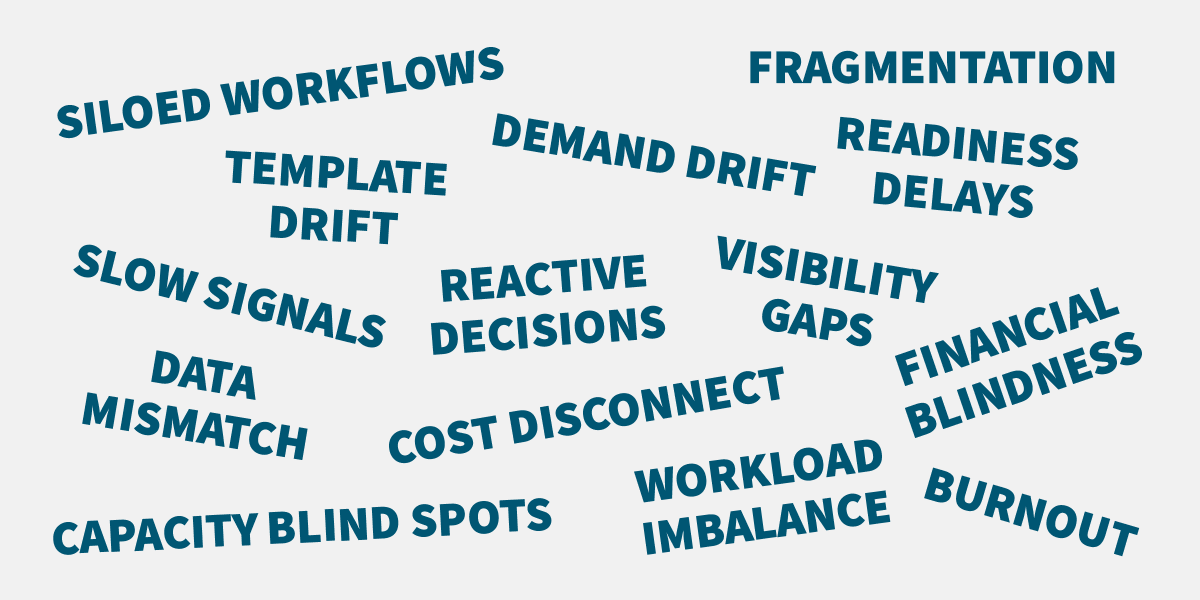
SUMMARY: Most healthcare staffing platforms promise efficiency, automation, and intelligence. Yet when you talk to operations teams, a different story emerges. They still work in spreadsheets. They still chase down answers by email. They still make decisions with data that doesn’t line up across teams. They still feel reactive instead of in control.
It raises a simple question: If staffing technology is so advanced, why do the same problems keep happening?
Because most platforms don’t address the actual operational challenges that drive staffing chaos. They automate tasks, not context. They centralize data, but not the realities that shape how decisions get made.
This post breaks down the operational problems most tools miss — and why ignoring them leads to the same outcomes, no matter how “intelligent” the system claims to be.
Problem 1: Eligibility & Readiness Signals Don’t Reach Scheduling Fast Enough
Credentialing signs off. HR updates the record. Compliance gives the green light. But scheduling never knows, at least not when it matters. This delay means:
- new hires sit idle unnecessarily
- internal providers get underused
- external labor fills gaps that didn’t exist
- leaders believe they’re short-staffed when they aren’t
Technology tends to store readiness data. It rarely moves readiness data to where decisions happen.
True operational intelligence requires real-time, cross-team signals. Not siloed status updates.
Problem 2: Internal Capacity Is Invisible (or Incomplete)
Most systems can show who is “available.” That’s not the same as showing who is:
- eligible
- appropriately balanced
- credentialed for the right departments
- not overloaded
- not underutilized
- capable of covering specific shift types
- already working too many weekends
This is the operational truth: Most organizations don’t struggle from a lack of staff — they struggle from a lack of visibility.
Without a clear picture of internal capacity:
- scheduling decisions skew reactive
- burnout patterns go unnoticed
- productive providers get stretched thin
- underused providers remain hidden
- locum spend increases unnecessarily
Tech that can’t surface true internal capacity will always push teams toward external solutions.
Problem 3: Workload Balance Isn’t Just a Wellness Issue — It’s an Operational One
Most tools track hours. Few track distribution. A provider working 36 hours isn’t the same as a provider working:
- three 12-hour shifts
- five split shifts
- shifts in multiple locations
- shifts that include on-call
- shifts that repeatedly fill last-minute gaps
Workload imbalance creates:
- early burnout
- unpredictable coverage
- rising external spend
- higher turnover
- morale issues across high-performing teams
If your system can’t see these patterns, it can’t support better staffing decisions — no matter how much automation sits on top of it.
Problem 4: Templates and Rules Drift Away from Reality
Healthcare staffing isn’t static. Demand shifts. Seasonality changes. Provider capacity fluctuates. Onboarding timelines slide. Local patterns evolve. Yet many tech systems continue to optimize against:
- outdated templates
- rigid staffing models
- assumptions that no longer fit
- incomplete provider profiles
- departmental rules that don’t match new realities
When the model drifts from reality, the recommendations drift too. Automation becomes noise instead of guidance.
Problem 5: Financial Impact Is Disconnected from Staffing Decisions
The biggest gap most platforms overlook? The financial layer. Schedulers make choices without real-time cost impact. Operations sees coverage, not spend. Finance sees totals weeks later. Leadership gets surprised at month-end.
Most systems can calculate:
- cost per hour
- shift differentials
- overtime
- invoice totals
But very few can answer:
- Was this shift cost-effective based on internal vs external options?
- Where are we consistently overspending?
- Are we deploying our internal workforce to its full potential?
- Which specialties or locations drift off budget the fastest?
Without connected financial context, automation can produce the wrong “optimal” outcome.
Problem 6: Staffing Decisions Happen in Silos — Even in Modern Systems
Technology often reinforces departmental silos, not solves them. Scheduling optimizes coverage. Finance optimizes spend. Operations optimizes flow. Clinical leadership optimizes quality. HR optimizes onboarding speed.
Every team is right individually yet misaligned collectively. When a system doesn’t support cross-functional visibility, it unintentionally strengthens the very divisions that make staffing chaotic.
Tools that don't support alignment end up amplifying misalignment.
Why These Problems Persist (Even with AI)
Because most tools weren’t designed by people who have lived the operational reality. They automate steps. They display data. They create dashboards. But they don’t understand:
- the nuance
- the timing
- the interdependencies
- the tradeoffs
- the way decisions cascade
- the human constraints
- the financial pressure
- the clinical expectations
AI won’t fix a model that doesn’t reflect real life. Operational clarity has to come first.
What Modern Staffing Technology Should Address
Here’s what high-performing teams actually need:
- real-time readiness and eligibility signals
- unified visibility across internal and external resources
- workload balance insights
- live cost and utilization context
- templates that evolve with real behavior
- scheduling tools that reflect true capacity
- systems that support alignment, not silos
Most platforms don’t address these needs. Kimedics does.
How Kimedics Helps Close These Gaps
Kimedics isn't “more automation.” It’s a different foundation entirely.
How? By connecting:
- credentialing
- readiness
- availability
- scheduling
- utilization
- locum performance
- financial impact
…Kimedics gives teams the ability to see and act on their entire workforce in real time.
This clarity reduces:
- drift
- burnout
- unnecessary external spend
- chronic reactivity
And it supports teams in making decisions that match real-world conditions — not system assumptions.
Operational Problems Don’t Fix Themselves. Visibility Fixes Them.
The limitations in most platforms aren’t small. They’re structural. They’re the reason healthcare staffing feels harder than it should.
Solving these gaps isn’t about adding smarter algorithms, it’s about building a clearer system. That’s the heart of Total Staffing Intelligence. And it’s where we’re headed in the next post in this arc: What High-Performing Teams Need From Technology in 2026
Ready to address the operational gaps your current tools ignore?
Request a Demo
Learn more about Kimedics
Kimedics is a provider utilization management platform. We help healthcare organizations gain visibility across internal and external staffing to reduce complexity and improve financial performance. For more information, book a demo or email kimedics@kimedics.com