

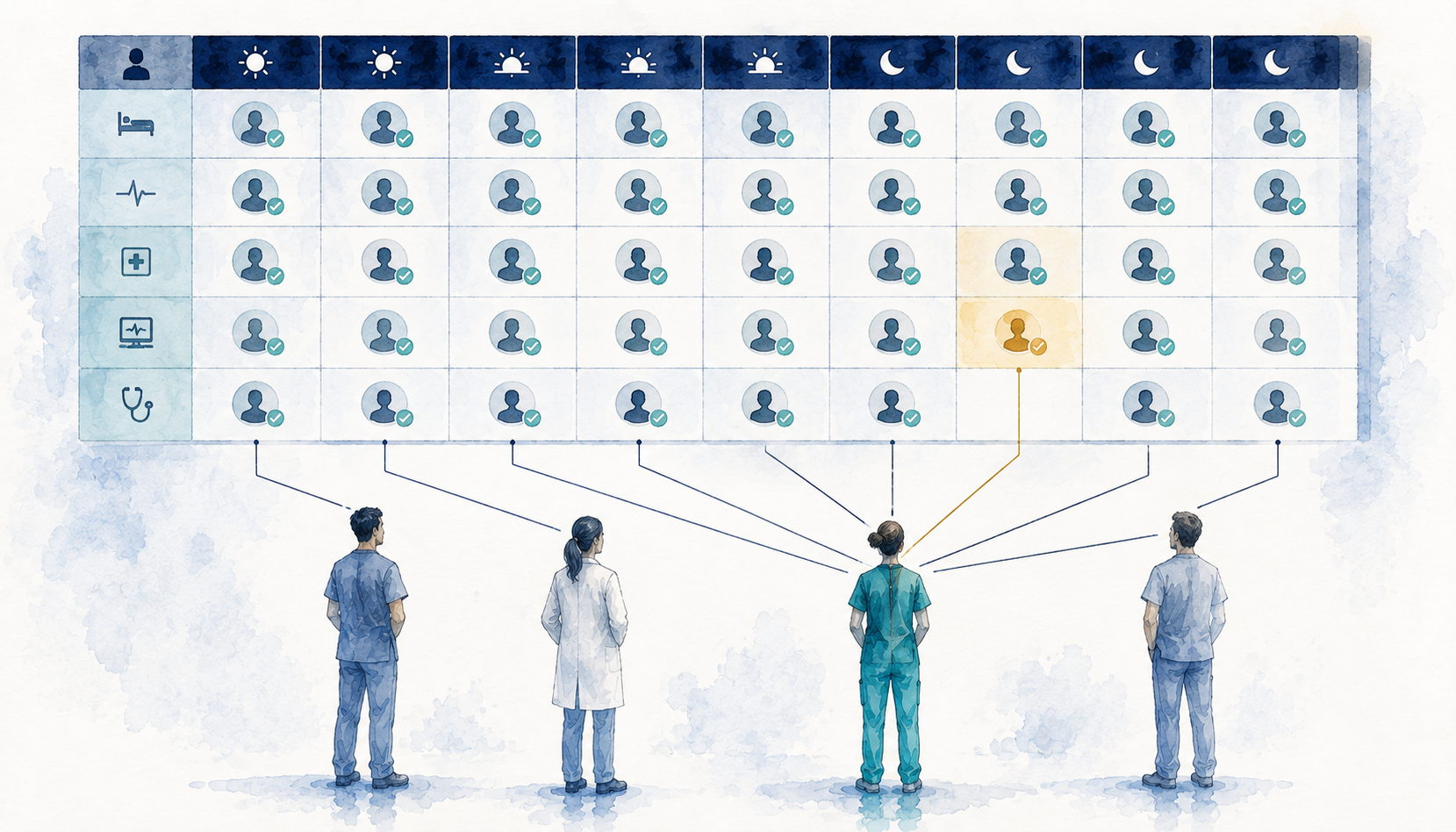
SUMMARY: In most operating reviews I sit in, coverage shows up as one number. Percent of shifts filled. Premium spend against plan. If both look okay, we move on.
What has changed is who hits the brakes when those numbers look fine. More often now, it's a clinical leader. A medical director or chief who has learned, sometimes the hard way, not to trust a clean coverage line at face value. They're not questioning the math. They're asking something the math was never built to answer: covered by whom, and how well.
That's a different question. And most operations aren't equipped to answer it.
A filled shift and a covered shift are not the same thing
The fill rate does one thing: it tells you a slot had a name on it before the shift started. That's it. It doesn't tell you whether that clinician had worked that unit before, whether they were on their fourth stretch in a row, or whether they were placed there because they were the only available name anyone could see at the time.
None of that shows up in the coverage report. All of it shows up in the care.
I run operations. I don't practice medicine. The clinical judgment belongs to the people who do. But the pattern underneath a quality problem is almost always operational. When a shift gets filled reactively, from whoever is visible in the moment, the decision is optimized for one thing: the slot is no longer empty. Fit and continuity aren't ignored on purpose. They're just not in view when the call gets made.
This looks like a coverage problem. It's actually a visibility problem
Run that across a full month and you have an operation that looks fine on paper and feels uneven to the people working in it. The same reliable clinicians absorb the hardest assignments because the system finds them first, every time. Continuity erodes in the units that can least afford it. Leaders sense the drift well before any report names it.
The clinical leaders I talk to aren't asking for another dashboard. They're asking for the coverage decision and the clinical context to live in the same place. Right now, the person making a placement can see availability and an open slot. What they can't see, in the same view, is everything that would make that placement a good one rather than just a completed one. Improve what they can see, and the quality of the decision improves without anyone working harder.
What getting this right actually looks like
The operations I see getting ahead of this describe it pretty plainly. Fewer placements that technically worked but probably shouldn't have. Less weight falling on the same small group of clinicians. Clinical leaders who trust the coverage line again, because they can see what sits behind it.
The schedule still changes, because clinical operations always do. What changes is that the decision and the context are finally in the same place when it matters.
This is the gap Kimedics was built to close: scheduling, credentialing, and workforce context in one connected view, so a coverage decision reflects whether a shift is being filled well, not just whether it's being filled.
Coverage has always been treated as an operations question and priced as a finance question. What I keep seeing is that it's also a clinical-quality question. The organizations figuring that out aren't adding a metric. They're closing the distance between the decision and everything that should inform it.
Q&A
Q: What does it mean to call coverage a clinical-quality question?
A shift being filled is not the same as a shift being covered well. Fit with the unit, continuity of care, and how hard a clinician has been working all shape the quality of a placement, and none of it appears in a standard coverage report. The number can look clean while the decisions behind it vary significantly.
Q: Isn't a high fill rate enough?
A fill rate tells you whether slots have names attached to them. It doesn't tell you how those placements were made or what they cost in continuity and clinician load. An operation can report strong coverage numbers and still be leaning on the same small group, placing clinicians where the fit was thin.
Q: Does this apply to staffing organizations as well as health systems?
Yes. A staffing organization making placements across multiple client sites faces the same quality-of-coverage decisions from the other side, usually with less visibility into each site. When both sides work from the same picture of availability, credentials, and fit, placements improve for everyone involved.
Q: How does Kimedics help?
Kimedics is the clinician workforce operations platform built by healthcare operators. It brings scheduling, credentialing status, and workforce context into one connected view, so coverage decisions reflect fit and continuity, not just an open slot that needed a name.
Ready to see whether your shifts are covered well, not just covered?
Request a Demo
Learn more about Kimedics
Kimedics is the clinician workforce operations platform built by healthcare operators. We help healthcare organizations gain visibility across internal and external staffing to reduce complexity and improve financial performance. For more information, book a demo or email kimedics@kimedics.com